The Pleiades Cluster – A Cosmic Jewel in Taurus
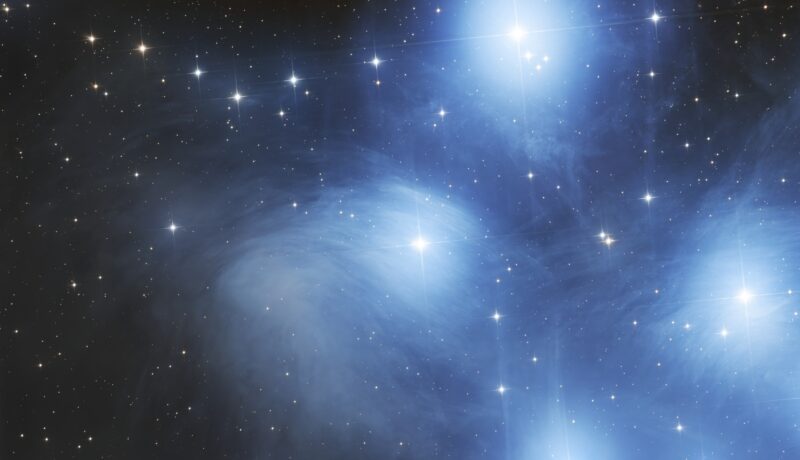
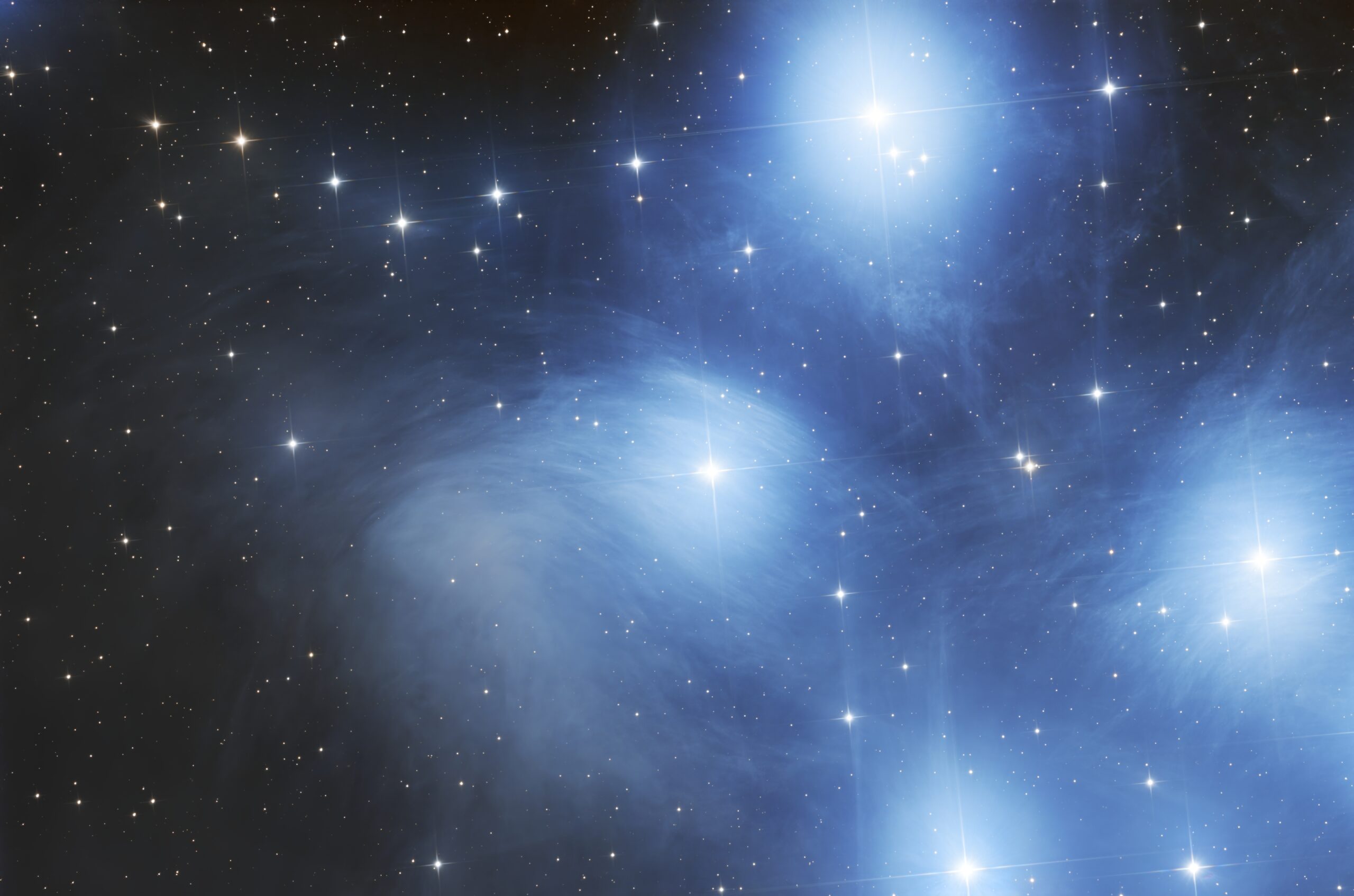
Few deep-sky objects capture the imagination of both beginners and seasoned astrophotographers like the Pleiades Cluster (M45). Suspended in the winter skies of the Northern Hemisphere, this nearby open cluster dazzles with its blue-white stars wrapped in delicate wisps of reflection nebulae—an irresistible target for anyone with a camera, a telescope, or simply a love for the night sky.
A Young, Glittering Family of Stars
The Pleiades lie approximately 440 light-years away and consist of more than a thousand stars, though only a few dozen are visible to the naked eye. Astronomically speaking, this cluster is still in its infancy—the stars are around 100 million years old, mere toddlers compared to our 4.6-billion-year-old Sun.
These bright B-type stars shine intensely, and their high-energy radiation illuminates surrounding interstellar dust, creating the iconic blue reflection nebula that makes M45 so photogenic.
Reflection Nebula or Remnant of Formation?
It’s a common misconception that the Pleiades nebula is leftover gas from the cluster’s formation. In reality, the cluster happens to be passing through a particularly dusty region of the interstellar medium. The stardust we capture in our images is not the birth cloud, but rather material the cluster is encountering as it moves through space.
This makes the Pleiades a dynamic snapshot of an ongoing cosmic interaction: starlight versus dust.
Why Astrophotographers Love M45
The Pleiades offer a rare combination of accessibility and challenge:
- Bright stars make framing and focusing easy.
- Large apparent size (over 2° across) provides a beautiful wide-field canvas.
- Faint dust lanes demand careful exposure and processing.
- Colorful contrast—deep blues against black space—looks stunning with long integration.
Imaging Tips for M45
- Use long integration: 3–10 hours helps bring out subtle dust filaments.
- Keep star halos under control: Pleiades stars are bright—use shorter sub-exposures or HDR blending.
- Maintain careful color calibration: The blue reflection nebula is sensitive to white balance and gradient correction.
- Dither frequently: Helps reduce noise in the dark regions between the stars.
- Avoid over-smoothing: The dust has natural texture—preserve it for a more realistic look.
A Story Across Cultures
Beyond its astrophysical beauty, the Pleiades are woven into human history. From Greek mythology’s seven sisters, to Japanese car culture (Subaru’s logo), to ancient Nordic navigation and the agricultural calendars of Indigenous peoples worldwide—the cluster has guided, inspired, and fascinated humanity for thousands of years.
A Winter Must-Shoot
For many astrophotographers, the Pleiades mark the beginning of “nebula season.” As the colder nights arrive, humidity drops, and the sky becomes transparent—perfect conditions to capture this cosmic gem at its best.
Whether you’re shooting with a DSLR on a small tracker or a dedicated astro rig under pristine skies, M45 offers a rewarding challenge and a chance to create one of the most iconic images in astrophotography.
For more technical details visit my Astrobin profile.