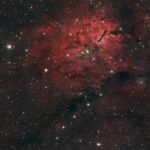
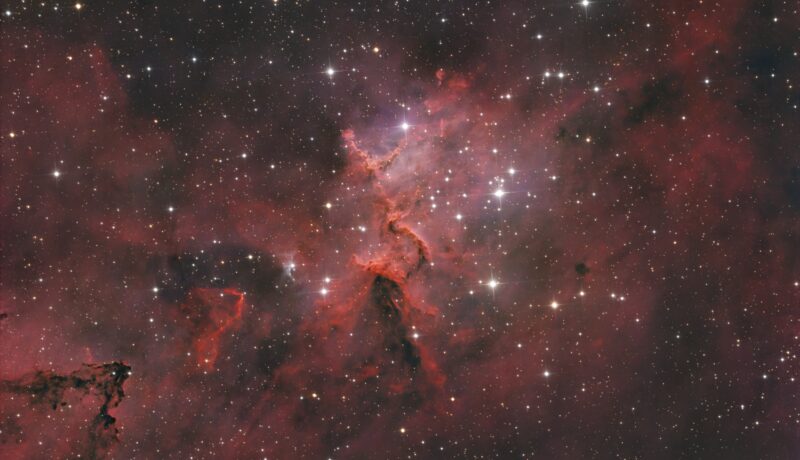
The Heart Nebula (IC 1805) is one of the most iconic deep-sky objects for astrophotographers—an enormous, glowing cloud of ionized gas and newborn stars that forms a striking heart-shaped structure in the constellation Cassiopeia. Located roughly 7,500 light-years away, this vast emission nebula stretches nearly 200 light-years across, making it one of the grandest star-forming regions in the Milky Way.
At its center lies Melotte 15, a young cluster of hot, massive stars whose intense radiation sculpts the surrounding gas into pillars, ridges, and delicate filaments. These stars emit strong ultraviolet light that excites the hydrogen in the nebula, giving it the deep red glow so common in H-alpha images. When captured through narrowband filters (Hα, OIII, SII), the Heart Nebula reveals an incredible palette of color and texture—swirling clouds, bright shock fronts, and intricate, lace-like structures that simply aren’t visible in broadband imaging.
For astrophotographers, the Heart Nebula is an inviting target for several reasons:
It’s bright in H-alpha, making it ideal for imaging even under moderate light pollution or with the Moon up.
It’s large, so short-focal-length refractors frame it beautifully, especially when paired with the nearby Soul Nebula for the classic “Heart & Soul” composition.
It rewards long integration, revealing deeper details in the central structures and faint outer wisps.
It’s visible for a good portion of the year, especially from northern latitudes.
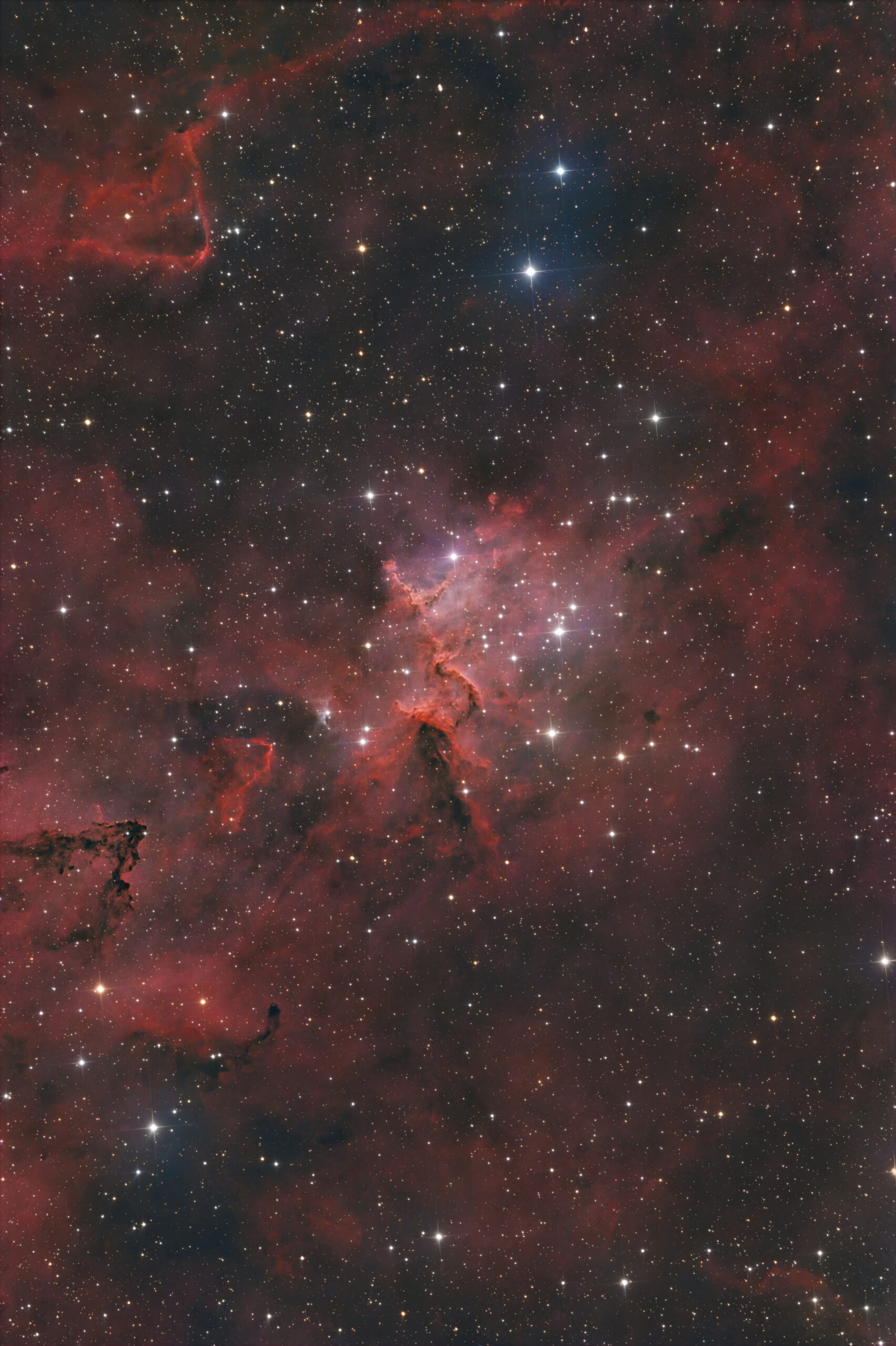
Capturing the Heart Nebula is more than just photographing an object—it’s documenting a dynamic, evolving region where new stars are born and cosmic shapes are continually carved by radiation and stellar winds. Every image, whether wide-field or focused on the core of Melotte 15, tells the story of creation on a galactic scale.
For technical details visit my Astrobinprofile.